Robotics and Jobs: What Automation Really Means for Workers
14 June 2026 · By Robots.mu · Updated 5 July 2026
No question about robotics gets asked more often, or answered more badly, than the jobs question. One camp promises mass unemployment within a decade. The other insists technology always creates more jobs than it destroys, so relax. Both are selling certainty that nobody has. The useful answer sits in the details: which tasks, which timelines, and who bears the cost of the transition.
Tasks, not jobs
The single most clarifying idea in this debate is that robots automate tasks, not jobs. A job is a bundle of tasks, and machines typically absorb some of the bundle while leaving the rest.
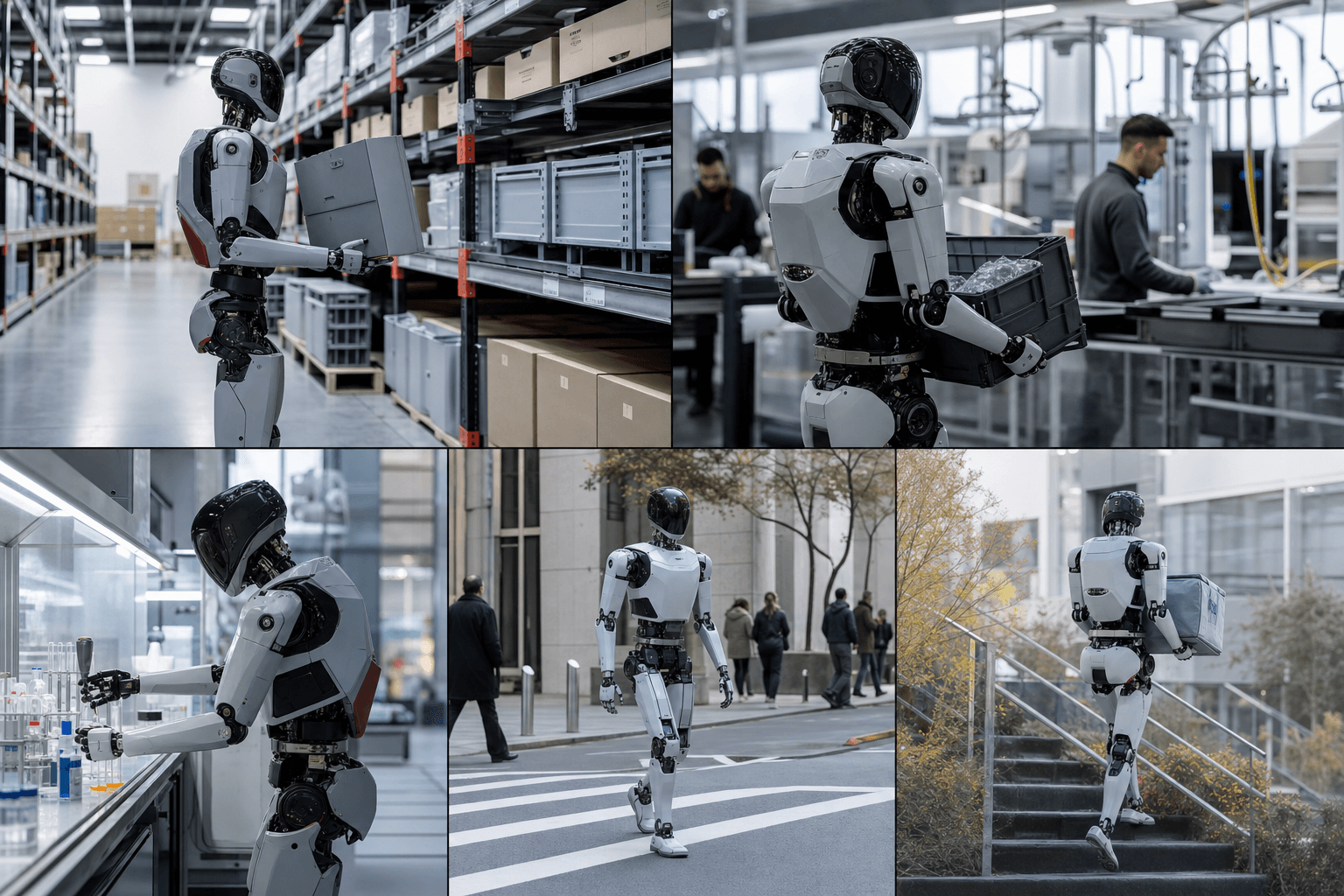
A warehouse picker's job includes walking, grasping, scanning, problem solving, and dealing with damaged stock. Robots have largely taken the walking. Humans still dominate the odd shaped grasps and the exceptions. The job did not vanish; it changed shape, and fewer people now handle more volume. That pattern, partial automation with rising productivity per worker, is the norm across manufacturing, logistics, and agriculture today, and it is a more accurate forecast than either extinction or business as usual.
What goes first, and what resists
Current robotics is best at work that is repetitive, physically defined, and performed in controlled environments. That puts pressure on machine tending, palletising, basic assembly, sortation, and routine inspection.
Work that resists automation shares different traits: unpredictable environments, fine manipulation of varied objects, and above all, human interaction. Plumbers, electricians, nurses, chefs in real kitchens, hairdressers, and caregivers are hard targets, not because their work is unskilled but because it is embodied, varied, and social. There is a genuine irony here: many trades dismissed as manual labour are safer from robots than plenty of office work is from software AI.
The lessons history actually teaches
Past technology waves did create more work than they destroyed, eventually. The caveat matters. "Eventually" spanned decades, and the people displaced were often not the people hired into the new roles. The weaver's job lost to the loom was not replaced by a loom mechanic's job in the same village at the same wage.
So the real policy question is not whether new jobs will exist somewhere, someday. It is how to manage the gap: retraining that actually works, safety nets that cover transitions, and education systems that produce adaptable people rather than task specialists.
The Mauritius angle
For Mauritius the calculus is distinctive. The economy leans on tourism, financial services, textiles, agriculture, and a growing tech sector. Hospitality is heavily interpersonal, which shields much of it. Textiles and agriculture face the same automation pressure they face everywhere, but the country's small scale means adoption will likely lag larger markets, buying time to adapt.
The bigger local risk may be indirect: if automation makes manufacturing cheap in high wage countries again, the traditional path of competing on labour cost erodes for everyone. The bigger local opportunity is the work automation creates around itself. Robots need integrators, technicians, fleet supervisors, data annotators, and software developers, and much of that work travels over a network cable. A country that trains for those roles can sell services to the robot economy without hosting the factories.
Practical advice that is not platitudes
For individual workers, a few concrete moves beat vague talk of lifelong learning:
- Move toward the exceptions. In any automating field, the humans who remain are the ones who handle what the machines cannot. Become that person.
- Learn to supervise machines, not compete with them. The picker who can also reset, troubleshoot, and log robot faults is more valuable than either skill alone.
- Value licensed and embodied trades. They are durable.
- Treat interpersonal skill as a hard skill. It increasingly is one.
The bottom line
Robots will not end work, and they will not leave work unchanged. They will keep dissolving the repetitive middle of physical jobs while raising the value of judgment, dexterity, and human contact. The outcome for any worker, and any country, depends less on the machines than on how early and how honestly the adjustment starts. That is a choice, and it is still open.
Robotics decisions begin with a measurable task. Explore the wider Nexus AI ecosystem.