The State of Robot Hardware in 2026: Hands, Actuators, and the Battery Problem
15 June 2026 · By Robots.mu · Updated 5 July 2026
Software gets the headlines, but every robot ultimately answers to physics. However clever the model, the machine still needs motors strong enough, hands dexterous enough, and a battery that lasts a working shift. So instead of another AI story, this is a tour of the physical stack: where robot hardware genuinely stands in 2026, component by component.
Actuators: the solved-ish problem
Actuators, the motors and gearboxes that move joints, have improved dramatically. The field has largely settled on electric actuation over hydraulics for humanoids and mobile robots: cleaner, quieter, cheaper to maintain, and much easier to control precisely. High torque density motors paired with planetary or harmonic gearing now deliver enough strength for a human sized machine to walk, lift, and carry usefully.
The remaining fights are about cost, durability, and backdrivability, the property that lets a joint yield when pushed, which matters enormously for safety around people. Actuators remain one of the biggest cost lines in a humanoid, and every serious manufacturer is vertically integrating them to drive prices down. Expect steady, unglamorous gains here rather than breakthroughs.
Hands: still the frontier
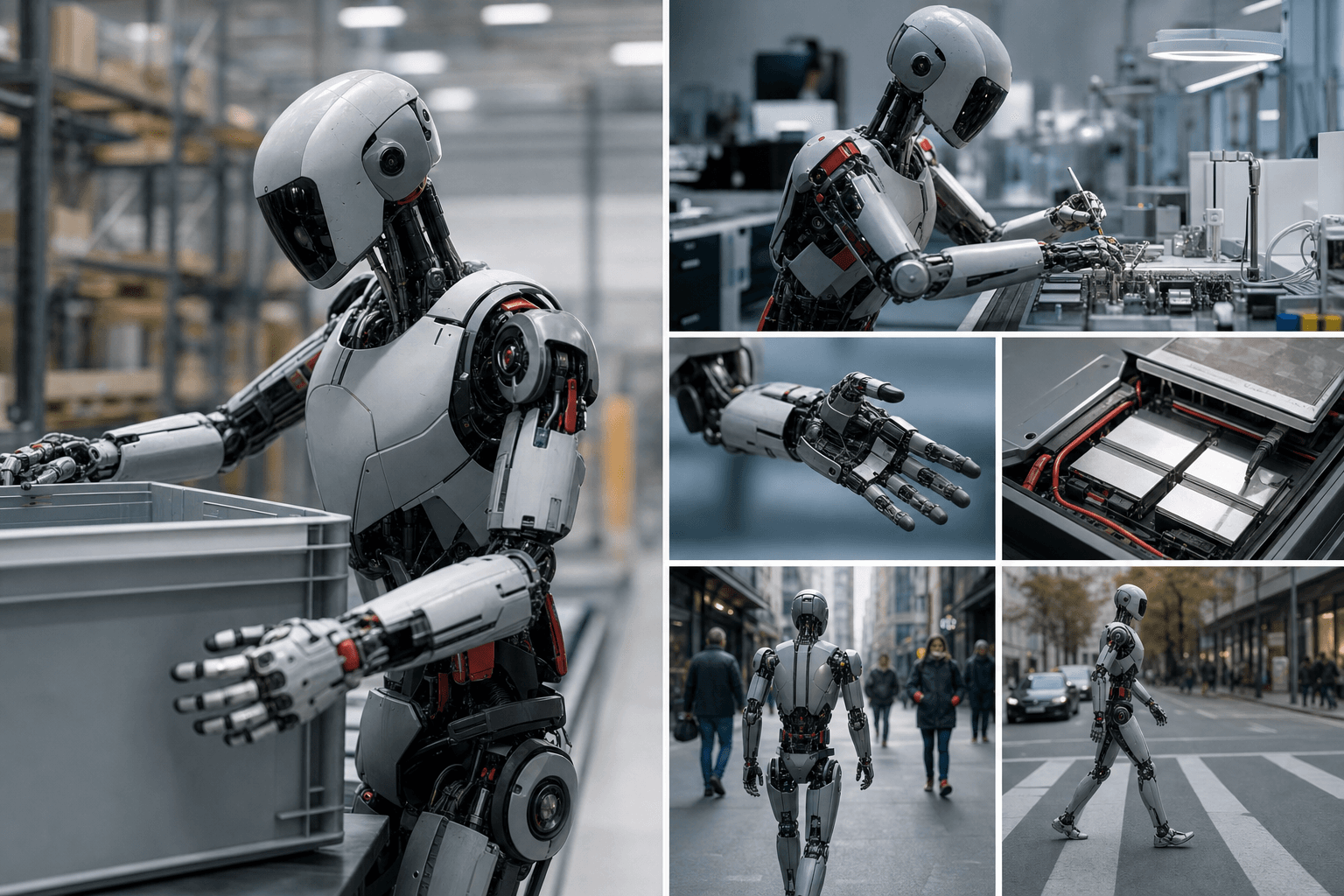
If you want to know how far robotics has to go, look at the hand. The human hand has roughly two dozen degrees of freedom, thousands of touch receptors, and self repairing skin. Robot hands in 2026 span a spectrum. At one end sit simple two finger grippers and suction cups, which remain the honest workhorses of industry because they are cheap and reliable. At the other end sit multi fingered dexterous hands with tactile sensing, which are improving fast but still fragile, expensive, and hard to maintain.
Tactile sensing is the quiet battleground. Vision alone cannot tell a robot how hard it is squeezing an egg. Skins, fingertip sensors, and force feedback are advancing, but nothing yet approaches biological touch. Most practical deployments still design the task around the gripper rather than the other way round. Whoever cracks a durable, affordable, sensate hand changes the whole industry's ceiling.
Batteries: the unforgiving constraint
A humanoid robot spends energy constantly just standing and balancing. Current machines typically manage a few hours of real work per charge, which is why serious deployments plan around swappable packs or docking schedules rather than pretending the problem away. Robotics rides the electric vehicle battery curve, so energy density keeps improving steadily, but there is no imminent leap. For the rest of the decade, expect battery management, fast swapping, and opportunistic charging to matter more than raw cell chemistry.
Heat is the related, underrated constraint. Motors, computers, and batteries all shed heat, and a sealed robot working in a tropical warehouse, the kind found across Mauritius and the wider region, faces cooling challenges that polite lab demos never show. Climate resilience, including humidity and salt air tolerance for coastal environments, is a real engineering line item.
Sensors and compute: the cheap part
Perception hardware is the good news story. Cameras, depth sensors, IMUs, and lidar have all become dramatically cheaper thanks to smartphones and autonomous driving. Onboard compute powerful enough to run modern perception models now fits in a robot torso at reasonable cost and power draw. Very few robots today are limited by their sensors. They are limited by what their software makes of the signal, and by the mechanical parts listed above.
What the whole stack adds up to
Pulling it together, the 2026 hardware picture looks like this:
- Locomotion is broadly solved for flat and moderately rough environments.
- Manipulation is solved for simple grasps, unsolved for general dexterity.
- Endurance is a planning problem, managed with swaps and docks, not yet an engineering triumph.
- Cost is falling fast, with credible humanoids now priced like a car rather than a house, and further declines expected as volumes rise.
The practical conclusion for buyers and observers alike: judge any robot claim against the hardware, not the highlight reel. Ask about hours between failures, grip variety, runtime under load, and service costs. The machines are getting real, but the spec sheet, not the demo video, is where the truth lives.
Robotics decisions begin with a measurable task. Explore the wider Nexus AI ecosystem.