What Embodied AI Actually Changes: From Talking Machines to Acting Machines
13 June 2026 · By Robots.mu · Updated 5 July 2026
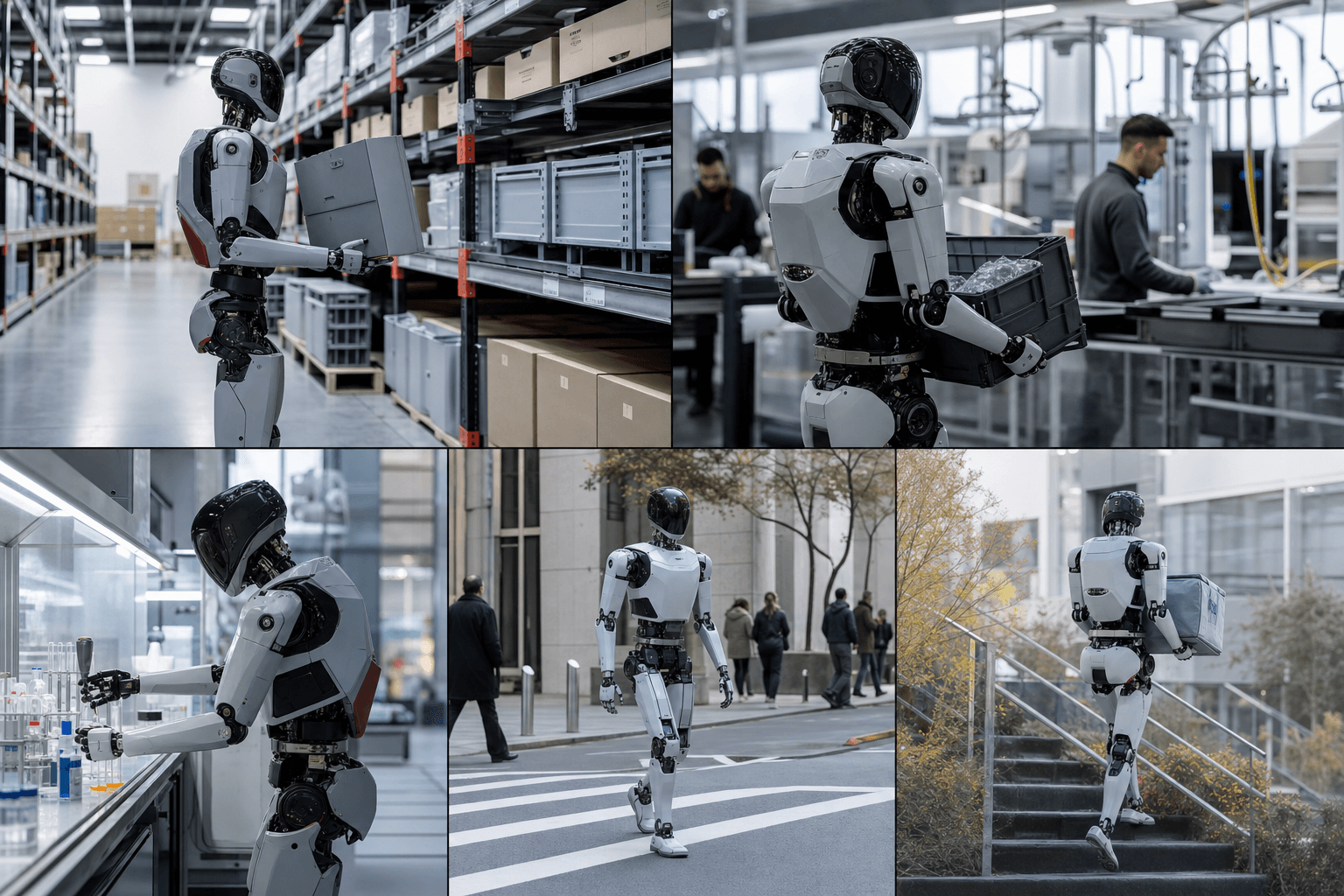
The first wave of modern AI lived on screens. It wrote, summarised, translated, and generated pictures. Impressive, but contained: when a chatbot makes a mistake, you get a wrong paragraph. Embodied AI is the next step, intelligence connected to motors, grippers, wheels, and legs. When it makes a mistake, something in the physical world breaks. That single difference reshapes everything about how this technology develops and what it means.
From words to atoms
Software AI scaled quickly because its raw material, text and images, was already digitised and abundant. The physical world offers no such shortcut. There is no internet scale archive of "how it feels to grip a wet glass." Embodied AI teams must generate their own data through teleoperation, simulation, and fleets of robots learning on the job, which is slow and expensive.
This is why progress in robotics looks gradual next to the leaps in language models. It is not that roboticists are behind. It is that atoms are a harder medium than words. The encouraging news is that the same recipe, large models trained on large data, does appear to work for physical skills. Robots trained this way generalise across tasks in ways scripted machines never could.
The economic logic
Why does this matter beyond the technology itself? Because most of the world's work is physical. Cleaning, building, harvesting, cooking, moving goods, caring for people: the majority of human labour involves manipulating objects, not documents. Software AI, for all its power, only touches the desk bound fraction of the economy. Embodied AI addresses the rest.
That is the reason capital is flooding into robotics. The prize is not a better chatbot. It is the automation of physical work itself, a market that dwarfs anything software alone can reach. Even slow, partial progress toward that goal reorganises industries.
What changes in practice
The near term effects are concrete rather than cinematic:
- Factories and warehouses get machines that can be retrained by demonstration instead of reprogrammed by engineers, which makes automation viable for smaller production runs and smaller companies.
- Dangerous work moves to machines first. Inspection of confined spaces, work at height, handling hazardous materials: these are jobs where a robot failure costs money instead of a life.
- Agriculture gets selective machines, able to distinguish ripe from unripe, crop from weed, and act on the difference.
- Care and assistance eventually gain machines that can fetch, lift, and steady, a serious matter for every country with an ageing population, Mauritius included.
The safety question becomes physical
With chatbots, the safety debate is about misinformation and misuse. With embodied AI it is about kinetic energy. A machine that can lift a crate can hurt a person. This is why the industry's real race is not toward maximum capability but toward provable reliability: machines that fail predictably, stop safely, and can be certified for shared spaces. Expect standards, insurance, and regulation to shape this field as much as algorithms do. Countries that write sensible rules early will attract deployments; countries that write none will get uncontrolled experiments.
Why this matters from a small island
It is tempting to file embodied AI under "problems for big countries." That would be a mistake. Small economies feel platform shifts through trade, tourism, and labour markets whether they participate or not. The more useful posture is the one Robots.mu exists to encourage: watch closely, learn cheaply from others' pilots, and build the human skills, in maintenance, integration, software, and policy, that every wave of automation ends up demanding.
The honest summary
Embodied AI does not mean androids everywhere next year. It means the slow, compounding transfer of physical tasks from people to machines, starting where work is structured and dull, spreading as reliability improves. The chatbot era changed what we do with information. The embodied era changes what we do with our hands, and that is a far bigger story, unfolding on a far longer clock.
Robotics decisions begin with a measurable task. Explore the wider Nexus AI ecosystem.